Designing Connected Worlds: The Strategic Value of Isometric 3D Bridge Assets
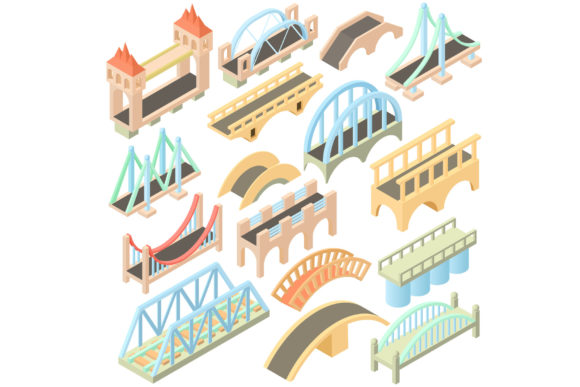
In the rapidly evolving landscape of digital interface design, the demand for visual clarity and spatial depth has never been higher. Designers and developers are constantly searching for assets that can convey complex structural concepts without overwhelming the user. Among the most versatile tools in this regard is the Bridges Set, Isometric 3d Style. This collection of universal bridges icons serves as a foundational element for web and mobile UI, offering a unique blend of aesthetic appeal and functional utility. By utilizing isolated vector illustrations available in formats such as JPG, EPS, AI, PSD, and PNG, creators can construct intuitive navigation systems and informative graphics that resonate with a broad audience.
The Evolution of Isometric Design in User Interfaces
Isometric projection has transitioned from a niche technical drawing method to a dominant style in modern digital design. Unlike perspective drawing, which mimics how the human eye sees distance, isometric design maintains parallel lines and consistent scale, creating a "2.5D" effect that is both playful and precise. When applied to infrastructure elements like bridges, this style allows designers to depict connectivity and transition in a way that feels tangible yet stylized.
The Bridges Set, Isometric 3d Style capitalizes on this trend by providing pre-rendered or vector-based assets that adhere to strict geometric rules. This consistency is crucial for maintaining visual harmony within an application. When a user encounters a bridge icon in a mobile app, they should immediately understand its function—whether it represents a literal crossing, a metaphorical connection between data points, or a progression step in a workflow. The three-dimensional aspect adds a layer of sophistication, making flat interfaces feel more interactive and engaging without sacrificing load times or performance.
Technical Versatility Across File Formats
One of the primary advantages of professional asset packs is the diversity of file formats provided. A comprehensive Bridges Set typically includes JPG, EPS, AI, PSD, and PNG files, each serving a specific purpose in the design workflow. Understanding when and how to use these formats is essential for maximizing efficiency.
- AI and EPS (Vector Formats): These are the gold standards for scalability. Because they are based on mathematical paths rather than pixels, vectors allow designers to resize bridge icons from a tiny favicon to a massive billboard without any loss of quality. This is particularly important for responsive web design, where elements must look crisp on everything from a smartwatch screen to a 4K monitor.
- PSD (Layered Raster): Photoshop files offer deep customization. Designers can isolate specific layers of the bridge—such as the road surface, the suspension cables, or the supporting pillars—to change colors, add textures, or integrate shadows that match a specific brand palette.
- PNG (Transparent Raster): For quick implementation in web and mobile development, PNGs with transparent backgrounds are indispensable. They allow the isometric bridge to sit seamlessly over any background color or pattern, ensuring the UI remains clean and uncluttered.
- JPG (Compressed Raster): While less flexible due to the lack of transparency, JPGs are useful for static previews, documentation, or contexts where file size is a critical constraint and transparency is not required.
Having access to this full suite of formats ensures that the set of basic bridges elements isolated vector illustration can be adapted to virtually any project requirement, whether it is a high-fidelity prototype or a production-ready mobile application.
Practical Applications in Web and Mobile UI
The utility of universal bridges icons extends far beyond simple decoration. In the context of User Interface (UI) and User Experience (UX) design, these assets solve specific communication problems. Here are several key areas where isometric bridge assets prove invaluable:
Onboarding and Progress Tracking
Bridges are powerful metaphors for transition. In educational apps or complex software suites, a bridge icon can visually represent the journey a user takes from a novice state to an expert state. By placing isometric bridges between steps in a progress bar, designers can subtly encourage users to complete tasks, framing the process as a constructive journey rather than a tedious checklist.
Data Visualization and Infographics
For researchers and business owners presenting data, isometric illustrations add a layer of engagement that standard charts often lack. A Bridges Set, Isometric 3d Style can be used to connect disparate data clusters, illustrating relationships between different market sectors or demographic groups. The 3D nature of the icons helps them stand out against flat graphs, drawing the viewer's eye to critical connection points.
Gaming and Interactive Storytelling
In the gaming industry, particularly for strategy and simulation games, isometric assets are a staple. Developers can use these bridge elements to build levels dynamically. Because the assets are often designed as modular components, a game engine can assemble different types of bridges—suspension, arch, beam—to create unique landscapes. This modularity saves countless hours of modeling while ensuring a consistent art style.
Logistics and Mapping Services
Navigation apps and logistics platforms rely heavily on clear iconography. An isometric bridge icon can denote specific route features, such as toll bridges, construction zones, or scenic routes. The depth provided by the 3D style helps distinguish these icons from standard 2D map markers, reducing cognitive load for drivers and planners who need to process information quickly.
Design Considerations and Best Practices
While the aesthetic benefits of isometric design are clear, implementing them effectively requires adherence to certain principles. The goal is to enhance usability, not detract from it.
Consistency in Angle: True isometric design relies on a specific angle, typically 30 degrees from the horizontal. When integrating a Bridges Set into a larger design system, it is vital that all assets share this same angular perspective. Mixing different isometric angles or combining isometric items with flat icons can create visual dissonance that confuses the user.
Color Palette Harmony: Isometric objects have inherent lighting and shading due to their 3D form. When customizing these assets using PSD or AI files, designers must ensure that the chosen color palette respects these light sources. Adding a gradient that conflicts with the established shadow direction can make the object look "broken" or unrealistic.
Scalability and Detail: One common pitfall is using overly detailed assets at small sizes. An intricate suspension bridge might look magnificent on a desktop dashboard but become a muddy blur on a mobile notification icon. It is often necessary to create simplified versions of the bridge elements for smaller breakpoints, focusing on the silhouette rather than the texture.
The Role of Vector Illustration in Modern Workflows
The mention of isolated vector illustration in asset descriptions is not merely a technical specification; it is a workflow enabler. In agile development environments, requirements change frequently. A client may decide halfway through a project that the brand color needs to shift from blue to green, or that the style needs to be flatter. With raster images (like standard JPGs), these changes require starting over or accepting degraded quality. With vector-based bridges sets, these adjustments are instantaneous.
Furthermore, vectors are resolution-independent. As display technology advances—with Retina displays, 4K monitors, and even 8K televisions becoming standard—assets must future-proof themselves. A vector bridge icon created today will remain sharp ten years from now, regardless of pixel density improvements. This longevity makes investing in high-quality vector sets a sound economic decision for businesses and agencies.
Bridging the Gap Between Creativity and Functionality
Ultimately, the value of a Bridges Set, Isometric 3d Style lies in its ability to bridge the gap between abstract concepts and concrete understanding. Whether used by an educator explaining the physics of tension and compression, a developer building a city-building game, or a marketer creating an infographic about global trade, these icons serve as a universal language.
The isolation of elements within these sets allows for infinite recombinability. A designer is not limited to using the bridge exactly as presented. They can extract the roadway to create a path, use the pillars as structural supports for a diagram, or combine multiple bridge types to illustrate a complex network. This flexibility empowers creators to tell richer stories and build more intuitive interfaces.
As digital experiences become more immersive, the line between 2D and 3D continues to blur. Isometric design occupies a sweet spot in this spectrum, offering the depth of 3D with the simplicity of 2D. By leveraging comprehensive asset packs that include diverse formats like EPS, AI, and PSD, professionals can ensure their projects are not only visually stunning but also technically robust and adaptable to the ever-changing demands of the digital world. The humble bridge, rendered in crisp isometric detail, becomes more than just an image; it becomes a vital component of the user's journey through the digital landscape.